
Laundry Time Blog · For Landlords
Bound Brook, NJ
Every landlord asks sooner or later: which commercial laundry machines are actually best for a multifamily property? It depends on whether you're buying them yourself or working with a route operator—and on a few real-world details that matter more than a glossy spec sheet. 🧺
💡 Rule #1: All laundry machines need service every once in a while—so the best machine for your building is the one your service provider services best.
Whether you own the machines or run a revenue share room, every washer and dryer needs maintenance. Whoever services your equipment has to know that brand inside and out.
Under a revenue share, use the machines that operator services best. They get the strongest pricing on their primary line, and their technicians carry those parts on every truck. Talk them into a brand they rarely run, and even a great machine can sit out of order waiting on a special-order part—leaving you with downtime and frustrated tenants.
If you buy the machines yourself, make sure the seller or service company stocks the parts and has trained technicians for that brand. When more than one brand can be serviced well, sellers naturally lean toward the machine with the best markup. That's normal and doesn't mean the machine is bad; just ask for backing data and real performance history, not a pitch alone.
If you sign a revenue share agreement, read the equipment section closely. Some contracts say "like new," or list a model name, without stating that the machines must be new—even if someone told you they would be.
A refurbished, re-powder-coated machine can look brand new off the truck, yet the serial number can show it is 10 years old. Machines that age tend to start breaking down within a year. Used equipment can still make sense if you knowingly agree to it—for a better revenue split, or in a low-volume property where new machines wouldn't pay off. At Laundry Time, we always install new equipment unless we specifically discuss otherwise with you.
Commercial brands also differ mechanically. Some use direct drive; others use belts and pulleys. Some lines are known for sensitive electronics and expensive control boards, while others have doors that can pull off their hinges when residents lean on them.
Because every brand has trade-offs depending on your building and resident traffic, we keep brand-by-brand comparisons off our public blog. Call us anytime and we'll happily walk you through what holds up best in rooms like yours.
Machine choices hit your utility bills as much as vend revenue. Top loaders cost the least upfront, which is why they still get pushed into so many rooms, but they use twice the water and energy of an efficient front loader. Operators rarely pay the building's utilities, so that bill lands on you. Depending on how water is billed at your property, front loaders can save you real money over time, even with a slightly lower split. 💸
Electric dryers can cost twice as much per cycle as gas, or more. Whenever your building's utilities allow it, go with gas. In New York City and other large cities, hookups, venting, or permitting can make gas difficult, so electric is sometimes the practical fallback.
Standard top-load washers hold 18 lb; standard commercial front loaders hold 22 lb. A 30 lb washer is a major amenity tenants love—they can finally wash comforters, blankets, and bulky weekly loads in the building.
The right mix also depends on who lives in the building. If it's mostly singles and studios, residents do less laundry and run smaller loads, so you need fewer large machines—and top loaders can even work well, because people appreciate the smaller machines for those small loads. Buildings with families or larger apartments need plenty of 30 lb machines. That's what everyone will rush to.
The catch is installing traditional laundromat-style 30 lb and 40 lb hard-mount machines. They can cost an operator four times as much to install, must be bolted to concrete, and need a floor or gravity drain or water trough—so they won't work in a below-grade basement without one. Soft-mount laundromat versions skip the bolting for upper floors, but they add $3,000 to $4,000 or more per machine, and apartment laundry pricing won't pay that back.
That's why we use the LG Titan 30 lb soft-mount washer in almost every room we equip. It's only a few inches bigger than a standard 22 lb machine, installs with a hose and standpipe like a regular washer, lets you charge near laundromat prices, and tends to be the most-used machine in the room. 👍
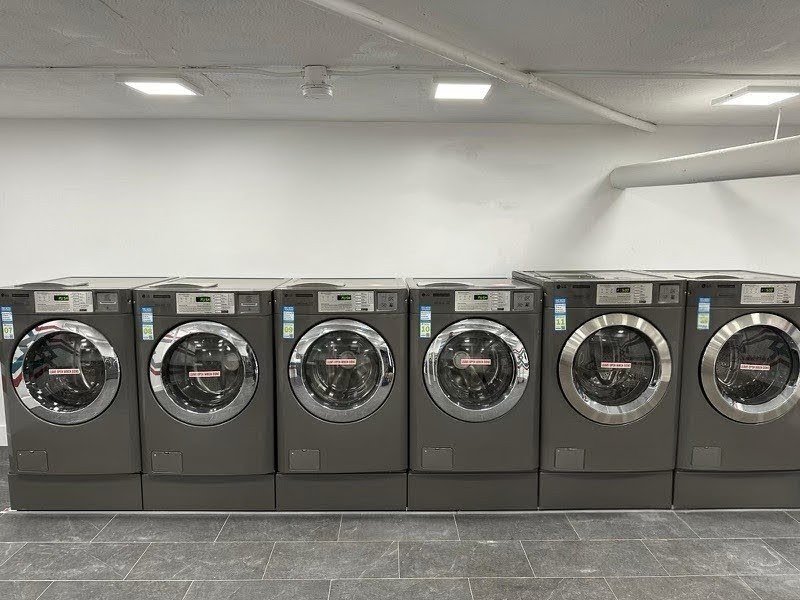
Dryer size and cycle time matter too. A standard 22 lb dryer takes 45 to 55 minutes on a normal load. Laundromat-style 30 lb dryers—most of them gas only—handle bigger loads and finish in 30 to 40 minutes, so residents get in and out faster. They're expensive and need large main venting ducts and enough gas BTU capacity. LG Titan also makes a 30 lb dryer that looks like a standard 22 lb unit, just a couple of inches bigger, and tenants love them. We're happy to share the spec sheets so you can check fit and utilities for your space.
📄 LG Titan spec sheets:
Even the best machines fall short if the room feels awkward or unsafe. A few practical details make a big difference:
The right machines in the right building make a real, long-term difference in laundry room performance and tenant satisfaction. At Laundry Time Services, that's what we specialize in—helping landlords pair reliable equipment, smart sizing, and clean room setup across New Jersey, the NYC area, Hartford and New Haven, Philadelphia to Lancaster, and Baltimore.
Start with who will service the room. Under a revenue share, use the operator's primary brand so their technicians carry parts on every truck and repairs happen fast. If you buy your own machines, choose a brand your seller or service company stocks parts for and knows inside and out.
Traditional laundromat-style hard-mount 30 lb and 40 lb machines need a floor drain and a concrete pad, which makes them tough or impossible in many apartment basements. Soft-mount options like the LG Titan 30 lb washer install with a standard hose and standpipe and are only a few inches larger than a 22 lb machine.
No. Buildings with mostly singles and studios do less laundry and smaller loads, so you need fewer large machines, and top loaders can even be fine. Buildings with families or larger apartments need plenty of 30 lb machines, because that's what everyone will rush to.
Security and evening access. Bright lighting and cameras help residents feel comfortable in a basement laundry room at night, and keeping the room open past 6 p.m. captures the 6 to 9 p.m. hours when most tenants actually do laundry.
Call 212-510-6555 or email office@laundrytimeservices.com


